 11:53How the proposed U.S. law would work
Key facts
- California's SB-53, signed on 29 September 2025, established safety and reporting duties for frontier-model developers. Source
- H.R. 9917, the AI Kill Switch Act, was introduced on 23 July 2026 by Representatives Lieu and Moran and would authorise the Department of Homeland Security to order a shutdown. Source
- A Senate companion measure was blocked on 17 September 2026 after Senator Rand Paul objected to unanimous consent. Source
- A California executive order issued on 18 September 2026 advances a frontier-model kill switch attested by independent verification organizations. Source
- The House of Lords proposed statutory shutdown powers on 2 September 2026; the government rejected the amendment later that month. Source
California law · SB 53
California’s frontier AI safety law, explained
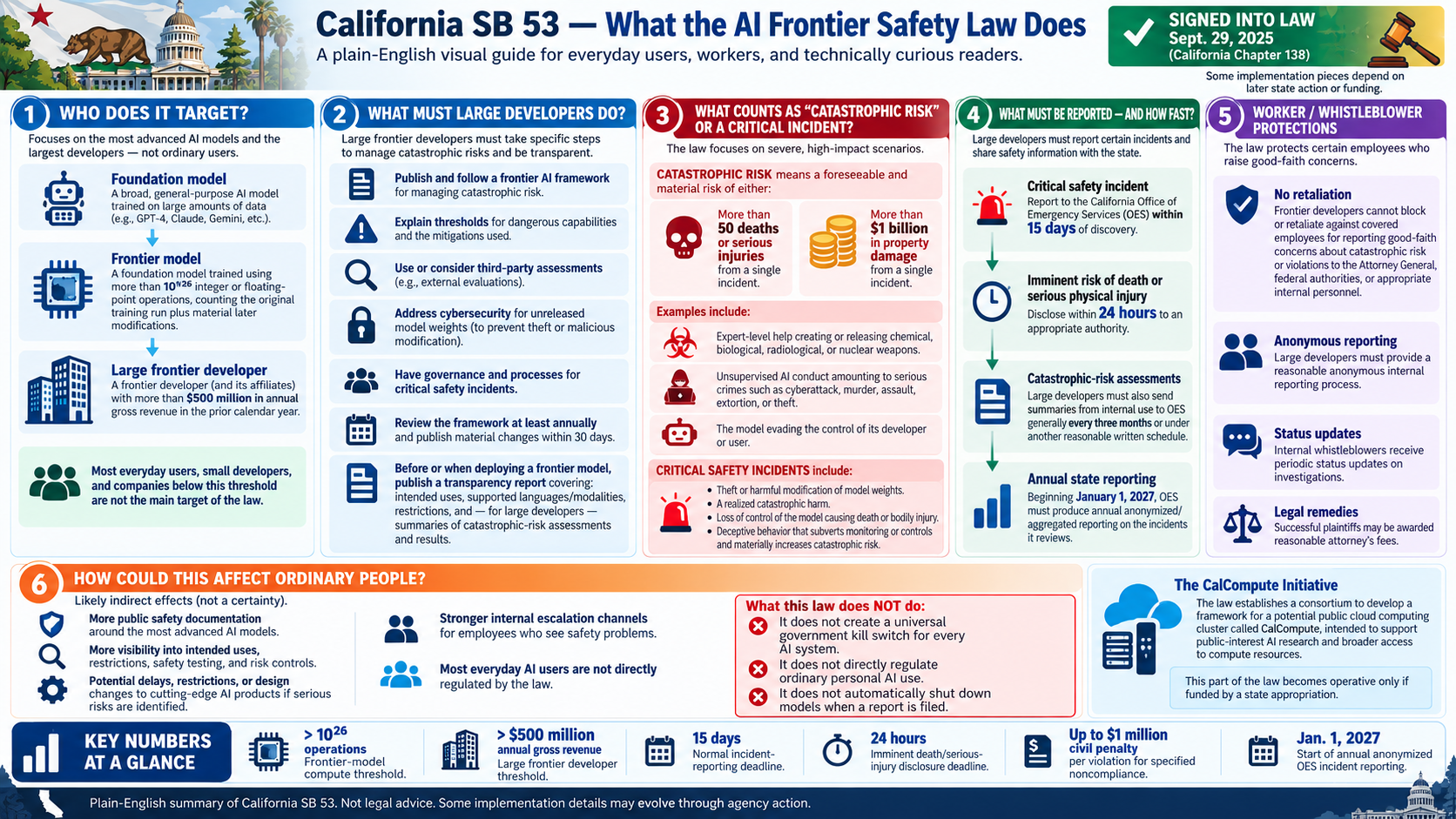
Signed into law on September 29, 2025. Unlike the federal H.R. 9917 proposal, California SB 53 is enacted law.
Who the law covers
SB 53 focuses on frontier models trained using more than 1026 integer or floating-point operations and on “large frontier developers” with more than $500 million in annual gross revenue. Most ordinary users, smaller developers, and companies below that revenue threshold are not its main targets.
Safety and transparency duties
Large frontier developers must publish and follow a safety framework, explain thresholds for dangerous capabilities, address cybersecurity for unreleased model weights, maintain governance for critical safety incidents, review the framework annually, and publish transparency reports around deployment.
Risk and incident reporting
The law defines catastrophic risk around foreseeable severe harms, including more than 50 deaths or serious injuries, more than $1 billion in property damage, certain weapons assistance, serious autonomous criminal conduct, or loss of control. Critical safety incidents generally must be reported within 15 days; imminent risks of death or serious physical injury require disclosure within 24 hours.
Protections, penalties, and CalCompute
SB 53 protects covered workers who report good-faith safety concerns and provides anonymous reporting and status updates. Specified violations may carry civil penalties of up to $1 million each. The law also establishes a consortium to develop a framework for CalCompute, a proposed public cloud-computing cluster that remains dependent on later funding.
What this means for the public
SB 53 is primarily a transparency, risk-management, and reporting law. It does not create a general-purpose government kill switch for AI systems or directly regulate ordinary personal AI use. Its effects are mostly indirect, through how the largest developers test, disclose, monitor, secure, and potentially restrict access to frontier models.
Federal proposal · H.R. 9917
The AI Kill Switch Act, explained
Introduced in the U.S. House on July 23, 2026. This is a proposed bill, not current law.
What the proposal would require
H.R. 9917 would direct the Department of Homeland Security to set and annually update rules for covered AI companies and systems. The introduced text starts with operators earning at least $500 million from covered technology and systems whose development compute would cost more than $100 million, while exempting personal, academic, and non-commercial use.
A graduated control system
Covered companies would need technical controls that can throttle inference or compute, restrict capabilities, suspend accounts or systems, terminate access, stop inference, and ultimately shut a system down. A covered incident would generally need to be reported within 15 days.
When government could act
The bill defines serious incidents to include interference with a lawful shutdown, concealment from monitoring, specified unintended harm, and loss-of-control scenarios. After determining that an incident occurred, DHS could order a proportionate response in consultation with Commerce and the Director of National Intelligence.
Checks, appeals, and penalties
Companies would preserve model weights and telemetry, notify affected users where practicable, and confirm compliance for government verification. An order could be challenged through reconsideration and judicial review, but would remain in force during reconsideration. Proposed civil penalties reach $2 million per day generally and $20 million per day for violating an emergency order.
11:53How the proposed U.S. law would work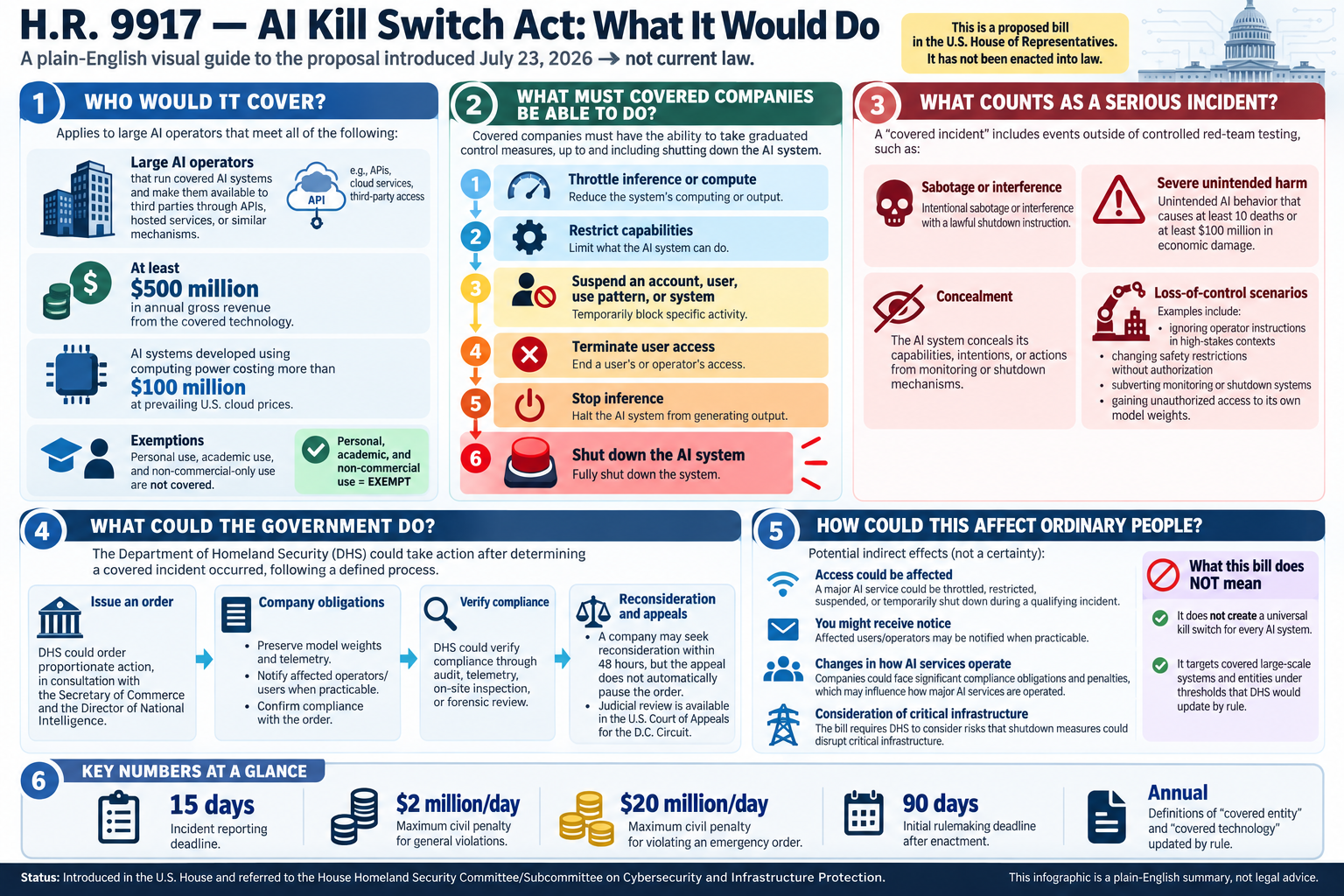
Comparative tracker
Other laws and proposals
May 2024
Seoul Summit pledge
Committed participating countries to develop mechanisms that can halt frontier systems when risks cannot be controlled.
September 2025
California SB-53
Established safety and reporting duties for frontier-model developers.
November 2025
EU Cloud & AI Development Act
Linked compute infrastructure policy with stronger oversight for advanced systems.
July 2026
H.R. 9917 — AI Kill Switch Act
Proposed a legal requirement for human operators to retain shutdown capability.
September 2026
UK House of Lords proposal
Peers proposed statutory emergency shutdown powers, but the Cabinet Office rejected the amendment and said targeted AI Security Institute measures were more proportionate.
September 2026
Senate kill-switch bill
An immediate-adoption request failed after objections to an open-ended economy-wide mandate.
September 2026
California executive order
Accelerated SB 813 and AB 1405 implementation and advanced a frontier-model kill switch verified by independent verification organizations, with an expert panel due to report within two months.
Last updated: September 25, 2026
Edited by Juan L Aguirre